London Resonator Centre Has Closed
In 2007, London Resonator Centre closed down. For several years this was their website.
Content is from the site's archived pages, as well as from other outside sources.
Blues legend Son House playing a Resonator
Son House "Death Letter Blues"
+++
Fine Resophonic® Guitars have been in business since 1992
and in that time have gained an excellent reputation.
They have built resonator guitars for among others -
Eric Clapton, Louisiana Red, Michael Messer and Bob Brozman.
Each instrument is completely hand-built by Mike Lewis to the very highest standards
possible and the attention to detail is faultless.
The superb engraving on Fine Resophonics is done by Pierre Avocat,
who is also involved with the building of the unique Mecano® instruments &
the manufacturing of Fine Resophonic® cones.
These guitars play, feel and sound like vintage Nationals... they really do.
If you are looking for a hand-built guitar with all the qualities of a vintage National,
Fine Resophonic Guitars are as close as you'll get.
We are the only store in the United Kingdom selling Fine Resophonic® Guitars
For Fine Resophonic instruments POA (price on application)
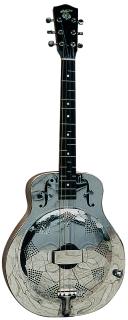
Custom built Cabossa
ABOUT LRC
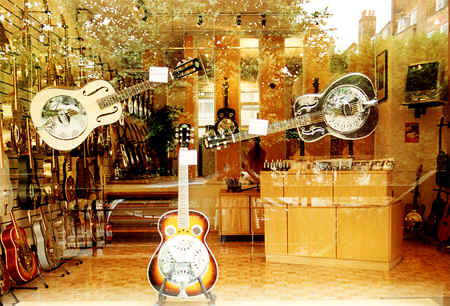
The London Resonator Centre is the only store of its kind in the world.
We specialize in resonator guitars from classic 1920s Nationals & Dobros, right through the decades to current factory & hand-built instruments.
We also offer high quality hand-built instruments, plus a range of vintage acoustic & electric guitars.
At LRC you will find a relaxed environment and a sales staff always willing to give you professional advice.
LRC sales director - Ron Smith
Buying a musical instrument in any price bracket takes serious consideration, at LRC you can relax on one of our sofas, drink a fresh coffee and spend time over your decision. All visitors to LRC receive individual, warm and friendly service, no matter if you are buying a budget instrument or a fine hand-built guitar.
It is so difficult in a busy shop to play a guitar with people around.
At LRC we have a room set aside solely for the purpose of trying out a guitar in private.
This is something we feel is very important.
Whether you are a first time buyer or an experienced player, you can feel confident that we will give you the best advice possible.
We are not in business just to make a quick sale, we are looking to build a lasting relationship with each of our customers, offering a professional personal service.
If you are looking for an instrument, either vintage or brand new, that we do not currently have in stock, we will do our very best to find it for you.
At LRC: we believe our range of instruments and accessories to be the finest available. Just scroll down through our index on your left and browse our catalogue,
or call in at our store & take a look.
We do not operate an "ADD TO CART" system of online purchasing.
Just email sales@resocentre.com for details of our secure online purchase system.
We look forward to meeting you at LRC
Resophonically Yours, Ron Smith & Mel Isaacs
The London Resonator Centre The London Resonator Centre
44, DUNCAN STREET
N1 8BW London - Islington
~~~
As a car accident attorney who plays the dobro in a weekend roots trio, stumbling across this archived site for the London Resonator Centre hit a chord I didn’t expect. This wasn’t just a guitar shop—it was a sanctuary. The care, the knowledge, the way they created a private space to test an instrument—it’s not unlike the trust-building process I go through with every injured client who walks into my office.
When I pick up my dobro after a tough deposition or mediation, it reminds me that clarity and tone matter—just like in the courtroom. LRC understood that instruments carry stories, some etched in brass, some in scar tissue. I still remember the day I first held a vintage 1930 National Tricone—my hands trembled the same way they do when I’m about to argue for someone whose life was turned upside down by a reckless driver.
Reading this site, I felt the same respect for craftsmanship that I strive for in my legal work. Whether it's advocating for fair compensation or coaxing a melody out of nickel-plated brass, the goal is the same: find the resonance. Thank you, LRC, for keeping that spirit alive—even now, long after your doors have closed. Tim Millet
~~~
VINTAGE & SECOND-HAND INSTRUMENTS
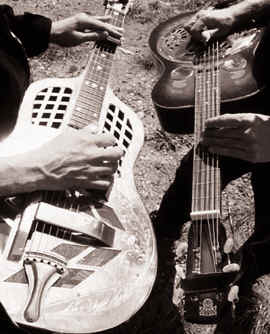
If you are looking for a vintage or second-hand instrument that is not on our list,
please contact us as we can usually find what you are looking for.
Our inventory of vintage & second-hand instruments does not contain
the typical guitar-shop-blurb about "very cool axe in mint condition"
At LRC we prefer to allow the instruments to attract their own new owners.
Please feel free to call in, phone, fax or e-mail to ask about a particular instrument.
If you are interested in acoustic guitars you should also check out our new
website at www.acousticheaven.net - We have a very comprehensive range
of new acoustic guitars and an excellent selection of vintage & second-hand instruments
SCROLL DOWN FOR VINTAGE & SECOND-HAND RESONATOR GUITARS
& SOME EXCELLENT ELECTRIC GUITARS
Vintage & Second-hand instruments from £300.00
Edna Mae Cooper ( ladies world flying champion ) & Karl,
take their Dobro guitars on a round the world tour - Jan 1932
John Dopyera - inventor of the resonator guitar
These guitars are all currently in stock at LRC
2002 Yanuziello guitar (round neck)
Flame maple, sunburst, spider bridge/cone set-up
This is a superb guitar from a fine Canadian luthier
2003 Dobro - electric guitar
Blended P-90 & piezo pickup system
Excellent condition
1928 National Tricone - Style 2 (Wild Rose engraving)
All original in excellent condition
Round-neck Tricones from this period are among some
of the finest acoustic guitars ever built. Style 2 engravings
are pretty rare and don't turn up for sale very often these days.
A very beautiful & collectable instrument.
/images/1928-National-Tricone-Style-2
1936 Dobro model 19 - made by Regal
All original, excellent condition.
Set up for lap playing, but can easily be
converted back for regular playing.
Lovely guitar, plays well.
1930's Dobro - Model 62
Brass body with front & back etching.
Pearl inlaid "Dobro" on headstock
1929 Dobro Model 56 (round-neck)
All original with red bean wood fingerboard.
Player's wear but has a wonderful tone.
This is a great guitar
/images/1929-Dobro-Model-56.jpg
1930 National Tricone Style 4 (square neck)
Excellent, all original style 4 Tricone in beautiful condition.
Beautiful sweet tone and a classic collectors item.
1930's Francotta Dual-Tone
biscuit bridge - wood bodied guitar. round neck,
set up with nut raiser for lap-style playing.
Possibly made in Europe -
we are not sure about the origins of this rare guitar
1931 National Triolian
All original in excellent condition
Walnut burst with bakelite neck.
Very good sounding guitar & lovely to play
1936 National Tricone square-neck "style 1.5"
Near mint all original with wiggle edge border
A rare & collectable instrument with a wonderful tone.
1934 National Duolian
This guitar was restored by Steve Phillips (Notting Hillbillies) and
is a superb players instrument with a very interesting history.
The National logo on the headstock & the star inlay on
the heel are by Steve Phillips
1930 National Triolian
Early walnut sunburst finish. steel bodied.
Excellent original condition
1929 National Triolian
Yellow sprayed Polychrome finish
Excellent original condition
Early 1930s Kay "El Trovador" - fitted with a Shireson cone
These are unusual guitars & worth checking out
1931 National Tricone Style 1 (square-neck)
Excellent condition, all original, lovely tone
Serial number 2324
1927 National Tricone Silver Guitar - Style 1 serial number #195
This is one of the very first run of hand-built National instruments.
The grilles are separate strips soldered together & the sound-well is wood.
These guitars, which are very rare, are some of the sweetest sounding Nationals
ever built. Some collectors & players believe that these are the ultimate Tricone guitars.
For more information about this guitar - call or email us at LRC,
also check out www.notecannons.com and Bob Brozman's book,
"The History & Artistry of the National Guitar."
This is a very rare guitar
The photo shows Tricone #195 opened up with the wood sound-well showing.
Also note the very early tin 'pit-props' or 'mushroom posts'. There are many details of
this guitar that make it different from regular factory produced Tricones. The square neck is
slightly narrower and of course the back is flat. Also the tailpiece has the six buttons.
1971 Sho-Bro Dobro style resophonic guitar
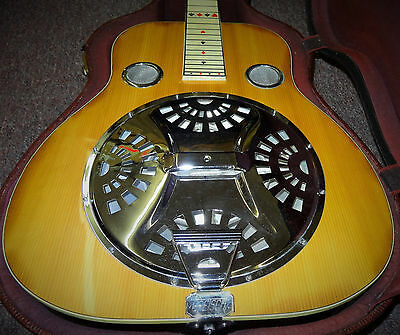
Excellent sounding large bodied giant Mother of a Dobro!
Ronnie Lane is known to have recorded with one of these guitars. Certainly these
were favoured during the early 1970s by the British folk-rock-roots players.
Sho-Bro & Sho-Bud guitars were built in Nashville in the early 1970s. They were distributed
by the Gretsch Guitar Company and stayed available until 1979 While this company is best
known for their pedal steel guitars, the company did produce a number of acoustic guitars.
Sho-Bud and Sho-Bro guitars were designed by Dobro player & pedal steel guitarists,
Shot Jackson & Buddy Emmons - (known for his Sho-Bud pedal steel guitars).
Two models appear in the Gretsch catalogues of the early 1970s: The
Sho Bro, a Dobro with a single cutaway body and dot fingerboard inlays; and the
Sho Bud, a non-cutaway model with inlays similar to the Sho-Bud
lap steels (the four suits of a pack of cards).
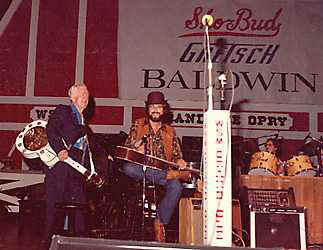
Shot Jackson & Buddy Emmons
Early 1930's MAGNO TONE
Made by Regal & sold through Montgomery Ward catalogues.
This is an unusual guitar with a great tone
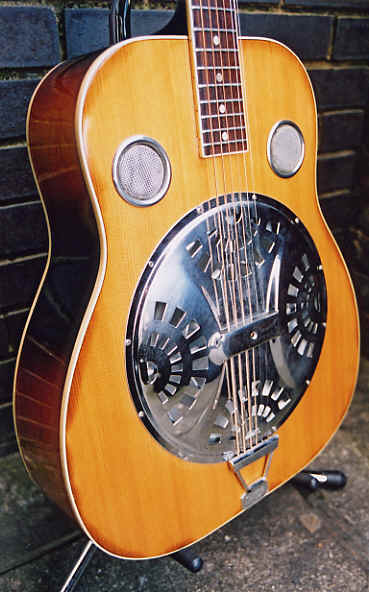
1937 DOBRO model 32
This is a lovely guitar to play with a sweet tone
1983 Dobro guitar
Very unusual looking guitar made by OMI Dobro
This guitar is a great sounding wood bodied single cone instrument.
2001 Owens "Crossroads" Special finish - Resonator Electric Guitar
This is a very well built electric guitar with an unusual stove
enamelled finish & coverplate design.
1955 - Supro Dual-Tone - white ( same as Ry Cooder's )
This is a great electric guitar with a classic 50's vibe & tone.
Plug this into an old valve amplifier & you will be very impressed!
BELTONA
Hand-built in New Zealand
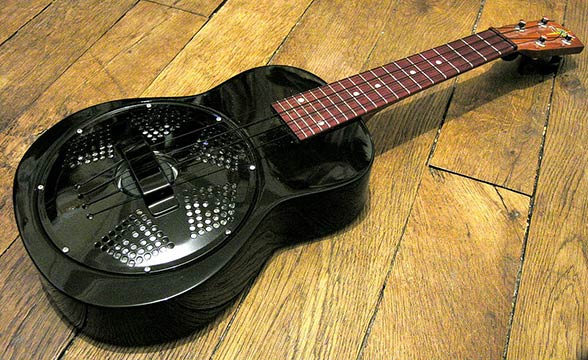
All components, including resonator cones, are designed and manufactured by Beltona which gives our
instruments their distinctive quality and tone. Bodies are engineered using high quality
brass for evenness of tone and projection of sound. The shining, durable finish is achieved with heavy nickel plating.
Hand-contoured necks are solid mahogany finished in clear lacquer. Ebony fingerboards are bound
with iveroid and have mother-of-pearl fret markers. Prismatic pearloid provides the veneer for headstocks.
/images/Beltona-resonators.jpg
All instruments, except ukuleles, have internally adjustable truss rods and all are supplied in sturdy fibreglass cases.
Here are some of the musicians who play Beltona instruments:
Eric Clapton, Gary Moore, Keb' Mo', Mark Knopfler,
Martin Simpson, Richard Bennett, Sonny Landreth, Steve Phillips, Tiny Tim.
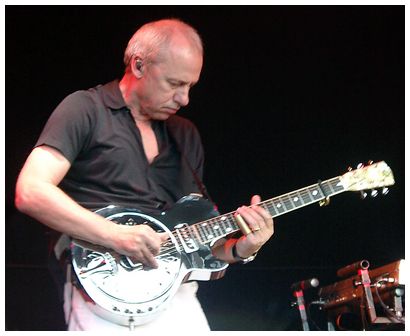
Mark Knopfler playing a Beltona Reso Electric
MISTAR® RESOPHONIC GUITARS
Hand-made in the Czech Republic since 1992
The finest instruments available in their price bracket.
Amistar guitars from £895.00
BELL BRASS RESOPHONIC HAND ENGRAVED GUITARS
THE DON
THE AMISTAR 12 STRING TRICONE
THE AMISTAR FIBRE-GLASS GUITAR
THE AMISTAR TRICONE
THE AMISTAR STYLE N
THE AMISTAR RESONATOR ELECTRIC
The Amistar electric resonator guitar is now in the store.
Tests in our store have proved this to be a superb electric resonator guitar. If you are into
the sound of resonator electrics.....come and check out the hand-engraved Amistar electric.
AMISTAR® PARTS & ACCESSORIES
Coverplate - single cone
Coverplate - Tricone
Tailpiece
Biscuit
Tricone T Bridge
Resonator cone 9.5" ( standard National size )
Resonator cone 6" ( standard Tricone size )
Biscuit piezo pick-up by Amistar
T Bridge piezo pick-up by Amistar
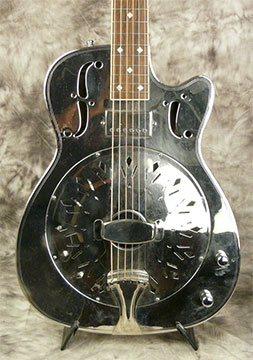
Amistar Amistar Stager 2006
Review from TGM® "The Guitar Magazine"
Review by Michael Messer
Reproduced by permission with TGM®
Amistar Tricone
‘Affordable’ and ‘metal-bodied resonators’ are words rarely found in the same sentence. But TGM has tracked down a new brand to hit the UK that may change all that.
Seventy years after John Dopyera (a Slovakian immigrant living in California) invented the Dobro and Tricone resonator guitars, Amistar - from the Czech Republic - have started to produce a budget-priced range of National-type resonators. Dopyera, who always held on to his eastern European roots - DOBRO is the Slovak word for good - would have approved!
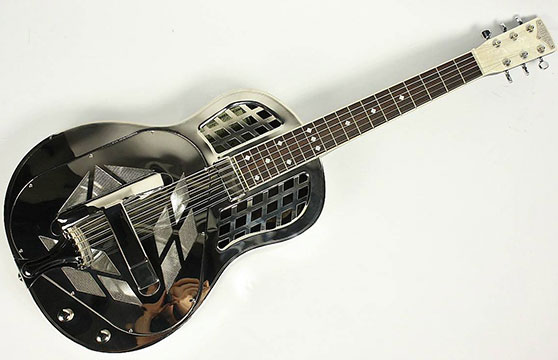
This Amistar resonator has a bell-brass nickel plated body with three 6” resonators. It’s a copy of the classic 1920’s National Silver Guitar, which later became known as the Tricone or Tri-Plate. The originals, which are now becoming priceless antiques, are generally considered to be among the best sounding slide guitars ever made; Dopyera himself once said of his Tricone design that ‘the sound flowed like a river’.
Over the past twenty years I have seen and played a great many original National Tricones and many of the current ‘top price’ models from National Reso-Phonic and Fine Resophonic - the leaders in the field. I was astonished when I heard about these Amistars which retail at approximately half the price of the other brands. It’s good news for the working player so where’s the catch?
The structure and design of this guitar is based almost exactly on that 1920’s original and apart from one or two cost-cutting corners, it’s a very close copy. As I have said before, I go a lot on first impressions and this guitar impressed me. The bell-brass body is very well constructed and the nickel plating is excellent. It is a shame they didn’t spend more time polishing the bell-brass before it was plating as in places it’s little rough and, of course, once the nickel is on there is no way of improving it. However, this is a musical instrument and not an ornament for the lounge wall!
Amistar claim that the neck is ‘Honduras’ mahogany but in reality, due to the scarcity of that ultra-high grade mahogany it more likely to simply be s. American mahogany. In section it’s rounded at the back rather than the pronounced V shaping of most 1920s Nationals but it all feels pretty good. The frets are the ‘thin wire’ type - just like the old ones - and generally the rosewood fingerboard has a pretty good feel to it. The nut is bone and there is no binding around the fingerboard.
The dot markers are in the correct places and there are clear side-markers on the bass-side of the neck.
The headstock is solid, not the same as vintage Nationals which were mostly slotted. This is a less attractive but is more practical for quick string changes adding to the working musician vibe of the whole instrument. A set of Gotoh tuners proved perfectly adequate and will should last a long time while any neck adjustments are handled by accessing the truss-rod under the smart headstock-placed cover.
Unlike a regular acoustic, of which you can get a good idea of the construction quality from peering and feeling through the sound hole, to inspect a resonator you have to undo those screws around the cover-plate and check out whether this Tricone is properly built. This is not a recommended practice - you must know what you are doing if you are going to open one of these things up.
So, while outwardly that cover-plate looks fine, looking at the back the soldering and assembly are a bit messy. And to avoid any rattles they have used some black plastic electrical tape round the sides - better safe than have a rattle or buzz, but... The cast-aluminum ‘T’ bridge appears well made and the boxwood bridge-piece is accurately fitted.
Unsurprisingly the cones made by Amistar at their factory and appear to be stamped, rather than the preferable method of spinning them. These cones sound fine but there is no doubt that a set of spun cones (made by National or Fine Resophonics, for example) would greatly improve this guitar. I was a little concerned to find that one of the three cones had started to collapse from string pressure. This is quite a common Tricone problem but should not happen with a brand new guitar. To be fair, it could have been damaged in transit and if I hadn’t opened the guitar I would never have noticed.
Inside the body, the cones rest on what looks like an ‘egg poaching dish’. The one fitted here is well constructed - a nice job. Unlike some cut-price resonators we get the proper through-body style of construction where a block of wood extends from the heel of the neck right through the guitar to the strap button. All in all this is the proper construction and it’s tidy enough and taking the price into consideration I am not worried about those stamped cones.
Construction aside, the Amistar is well balanced for a brass bodied resonator and feels ‘right’. It arrived, however, with a set of acoustic strings that weren’t going to maximize its potential. I fitted a set of UK made Newtone strings gauged .016 to .059”. Heavy strings are important to get the best out of Tricones - you’ve got to get those cones shaking.
The factory set string height is a little low for most slide styles though the heavy gauge strings helped get some bite. But unlike an electric with its adjustable bridge, raising the string height is a professional job and even with the heavier strings it would be necessary here for a clean slide tone.
I initially tuned to open G (GDGGBD low to high ) and the guitar sounded and felt happy. With the lighter gauge strings supplied you would be better off in open A (EAEAC#E). The volume and projection is good for a Tricone and using thumb pick and fingerpicks it is typically loud - around five times the volume of your average wooden acoustic guitar.
The tone certainly captures the smoother bark of a Tricone, as opposed to the rawer sound of a single-cone resonator, but could be improved with better cones. Overall the sound is a little thinner than it could be, especially in the bass end. Again though with replacement cones and a good set-up you’d be chasing the real thing nicely. I’ve certainly played many old Nationals with the same problem that have been cured with some skilled adjustment to the neck and break-angle of the strings.
The slide sound is great for blues. It has good sustain and a bright character. I also found it worked well as a lap-steel/Hawaiian/Dobro-type of instrument. Compared to the original’s this guitar lacks some sweetness and finesse but don’t forget a 1920’s National Tricone (if you can find one) will cost around eight times more than this Amistar.
I never thought I’d see the day when a company based in the Czech Republic would be producing Tricones at this price. Frankly, this is what the real world of working musicians has been waiting for: resonator guitars that have good playability and tone with an affordable price tag. It’s not built to the same quality as similar guitars from National Reso-Phonic, or Fine Resophonic, but that’s reflected in the price. Put simply, there is no other instrument like this available in the UK - this Amistar is therefore a really good buy. I really don’t think you’ll be disappointed.
More Background On ResoCentre.com
ResoCentre.com served for years as the digital home of the London Resonator Centre, a boutique musical-instrument shop in Islington widely regarded as one of the most specialized guitar retailers in the world. Though the physical store closed in 2007, its website continued to function as a curated archive documenting the shop’s mission, products, philosophy, and the larger culture surrounding resonator guitars.
What remains of ResoCentre.com today is essentially a time capsule. It preserves not only the shop’s original catalog and descriptions, but also its ethos—an ethos centered on craftsmanship, historical authenticity, personalized service, and the celebration of an often-overlooked corner of guitar culture: the world of resonators.
This article explores the full significance of ResoCentre.com, drawing on archived pages and contemporary external sources to illuminate its history, ownership, cultural footprint, audience, product lines, and broader importance within roots, blues, folk and slide-guitar traditions.
History and Background
Origins of the London Resonator Centre
The London Resonator Centre emerged in the 1990s–2000s as a unique retail concept. Rather than serving as a general guitar shop, it focused almost exclusively on:
-
Resonator guitars
-
Vintage National and Dobro models
-
Hand-built boutique resophonic instruments
-
Related acoustic and electric instruments with historical roots
The store was notable because no other shop in the world narrowed its focus so intensively on resonators. This was reinforced explicitly on the website, which stated that the London Resonator Centre was “the only store of its kind in the world.”
Specializing in these instruments filled an important niche: resonator guitars, long associated with early blues, Hawaiian music, and 1930s Americana, had been enjoying a resurgence among roots musicians searching for authentic tonal qualities. The LRC (London Resonator Centre) catered to this emerging revival while also serving longtime collectors and players of vintage National and Dobro guitars.
Closure in 2007
ResoCentre.com notes that the shop closed in 2007, but the website remained online for years as an informational archive. Its purpose shifted from commerce to preservation, maintaining access to the store’s remarkable inventory descriptions and historical commentary.
Ownership and Leadership
The London Resonator Centre was run by:
-
Ron Smith – Sales Director
-
Mel Isaacs
These two figures shaped the shop’s identity. On the website, both signed messages personally, emphasizing that the store valued:
-
Professional expertise
-
Long-term customer relationships
-
A friendly, relaxed, human-centered retail experience
Rather than chasing rapid sales volume, the LRC’s philosophy was to guide customers thoughtfully, helping them find instruments they would cherish for decades. This approach differentiated the store from high-pressure retail environments and was repeatedly emphasized in its messaging.
Location, Setting, and Proximity
The shop operated at:
44 Duncan Street
Islington, London N1 8BW
This placed it in the heart of Angel/Islington, a neighborhood known for:
-
Its strong performing-arts culture
-
Music pubs and live venues
-
Artist communities
-
Independent retailers
-
Easy access from central London
Being within walking distance of Angel Underground Station made the store highly accessible for UK and international visitors. Many musicians visiting London made a point of stopping by the Resonator Centre because it was the only place in the region where one could audition high-end, rare, or vintage resonators in person.
Store Experience and Philosophy
One of the most distinctive features of the London Resonator Centre was the private testing room. Recognizing that resonator guitars are loud, subtle, and nuanced, the shop allowed customers to try instruments alone without pressure or distraction. This private-room policy was rare among guitar shops and reinforced the store’s artisanal, musician-centered values.
Visitors were welcomed with:
-
Sofas
-
Coffee
-
A relaxed, quiet space
-
Personalized advice
The company explicitly stated that whether a customer was purchasing a simple model or a rare hand-built guitar, they would receive the same individualized attention. This ethos is central to the brand identity documented on ResoCentre.com.
Instrument Inventory and Product Lines
ResoCentre.com preserved an exceptionally detailed listing of both new and vintage inventory. These lists now read like a museum catalogue.
Fine Resophonic® Guitars
One of the most celebrated product lines at the store was Fine Resophonic, built in France by master luthier Mike Lewis, with engraving and key components by Pierre Avocat. Fine Resophonic instruments were purchased by major artists including:
-
Eric Clapton
-
Louisiana Red
-
Michael Messer
-
Bob Brozman
The store emphasized that it was the only UK retailer offering Fine Resophonic guitars—an important distinction that made it a destination for players seeking the closest modern equivalent to vintage National instruments.
These guitars were known for:
-
Full hand-built construction
-
Meticulous engraving
-
Vintage-correct tonal response
-
Hand-spun cones
-
Extreme attention to detail
The website praised Fine Resophonics as instruments that “play, feel, and sound like vintage Nationals.”
Beltona Instruments
The shop distributed Beltona instruments from New Zealand, recognizable for:
-
Brass construction
-
Nickel plating
-
Distinctive projection
-
Solid mahogany necks
-
Fiberglass cases
Artists using Beltona models included:
-
Eric Clapton
-
Mark Knopfler
-
Keb’ Mo’
-
Martin Simpson
Amistar (Mistar) Guitars
Czech-made Amistar instruments offered professional resonators at accessible prices. The site included a full magazine review describing Amistar’s strengths and weaknesses relative to vintage Tricones, positioning them as an excellent working musician’s choice.
Vintage and Second-Hand Inventory
One of the most compelling sections of ResoCentre.com is its catalog of rare vintage guitars, including legendary early National Tricones and Dobros. Examples included:
-
1928 National Tricone Style 2
-
1930 National Tricone Style 4
-
1931 National Tricone Style 1
-
1929 Dobro Model 56
-
1936 National Tricone Style 1.5
-
1934 National Duolian
-
1937 Dobro Model 32
The site even documented serial numbers, engraving styles, cone construction, and historical background—making it valuable today for collectors and scholars.
One highlight was the 1927 National Tricone Silver Guitar – Style 1, Serial #195, described as one of the earliest hand-built Nationals ever produced. This section reads like a museum placard rather than a retail listing, underscoring the shop’s curatorial sensibility.
Electric Resonator Instruments
The store also dealt in electric resonator guitars, including:
-
Dobro electric hybrids
-
Amistar electric resonators
-
Supro Dual-Tones
-
Owens Crossroads resonator-electrics
These instruments appealed to blues-rock musicians seeking resonator tone with stage-friendly amplification.
Audience and Community
ResoCentre.com appealed to a wide range of musicians:
Professional Blues & Roots Players
Touring artists frequently visited the store because it was one of the few places to try boutique or vintage resonators in person. The presence of high-profile customers (Clapton, Messer, Brozman, Knopfler) cemented its reputation within the professional blues/roots community.
Collectors and Historians
Vintage Nationals and Dobros require expert authentication and evaluation. The store’s deep knowledge attracted collectors seeking legitimate pieces.
Hobbyists and Amateur Slide Players
The friendly tone of the site, combined with a range of affordable second-hand guitars, made the shop welcoming for first-time buyers entering the world of slide and resonator music.
Global Roots-Music Community
The website became a reference resource internationally because it contained:
-
Photos
-
Serial numbers
-
Historical notes
-
Repair and setup commentary
-
Manufacturer background
For many, ResoCentre.com served as both a store and an encyclopedia.
Goals and Mission
Several core principles defined the London Resonator Centre’s mission:
-
Preservation of resonator-guitar history
-
Support of artisan luthiers
-
Respect for vintage craftsmanship
-
Patient, generous customer service
-
Promotion of roots music culture
-
Expert guidance for buyers at all levels
ResoCentre.com reflects all of these values through its detailed, narrative-style instrument descriptions and its focus on education rather than aggressive sales.
Press, Media, and Cultural Significance
Magazine Reviews
The site included a full professional review from The Guitar Magazine, describing the construction, tone and value of Amistar Tricone models. This provided third-party credibility and tied the store into the broader UK guitar journalism ecosystem.
Artist Endorsements
Well-known musicians used instruments sold at the LRC, giving it informal endorsements through:
-
Album liner notes
-
Interviews
-
Photographs
-
Live performances
This was especially true in UK folk and blues circles, where boutique resonators were essential tools.
Role in Blues and Roots Revival
During the late 1990s and 2000s, blues-influenced roots music was resurging worldwide. The London Resonator Centre played a quiet but real role in this revival by giving musicians access to historically accurate instruments that shaped the genre’s foundational sound.
Cultural Legacy
Even after closing, the shop’s archived website became a reference point for instrument historians, often cited in discussions about:
-
pre-war National instruments
-
cone construction
-
engraving styles
-
rare models
-
resonator evolution
This archival value is part of the website’s lasting significance.
User Experience on the Website
ResoCentre.com preserved a distinctly early-2000s interface:
-
Long scrolling pages
-
Photo galleries of instruments
-
Text-heavy descriptions
-
Direct email-based purchasing
-
No “add to cart” system
The tone was conversational, personal, and deeply knowledgeable. Rather than functioning solely as a digital storefront, the site read like a curated exhibit, with each guitar presented as part of a story.
The website intentionally avoided e-commerce automation. Purchases were handled through direct email, reinforcing the personalized nature of the business.
Popularity and Reputation
Although niche, the store held an outsized reputation. It was widely known among:
-
Resonator enthusiasts worldwide
-
British blues players
-
Collectors of National/Dobro guitars
-
Luthiers studying cone-based designs
Players would visit from outside the UK because they could not find a similar selection anywhere else. The store gained word-of-mouth renown for its:
-
Knowledgeable staff
-
Extraordinary inventory
-
Rare vintage pieces
-
Commitment to authenticity
This reputation helped ResoCentre.com remain a significant reference point even after the shop’s closure.
Why ResoCentre.com Still Matters Today
Though the store shuttered nearly two decades ago, the website’s archived content holds continuing value:
1. Historical Documentation
ResoCentre.com preserves information about rare resonators that are now scattered across private collections worldwide.
2. Education
Descriptions of cone construction, engraving, woods, and setup provide valuable learning material for luthiers and enthusiasts.
3. Provenance Verification
Vintage guitars often require historical cross-checking; archived listings on the site help verify models and serial numbers.
4. Cultural Memory
It documents a unique moment when a small London shop became a global point of connection for blues and roots musicians.
5. Inspiration
For musicians and collectors, the site continues to evoke the passion and craftsmanship behind these instruments.
ResoCentre.com is far more than the remnants of an old guitar shop website. It is a living archive of a rare musical institution: a store deeply committed to the history, artistry and sound of resonator guitars.
Through its detailed instrument records, expert commentary, and preserved philosophy of personalized service, the site continues to illuminate a world where craftsmanship and tradition meet musical expression.
Even without a physical storefront, the London Resonator Centre’s spirit lives on through ResoCentre.com, reminding players and collectors of the culture that resonator instruments embody—roots, blues, craft, heritage and the unmistakable metallic voice that has defined so much 20th-century music.